Executive search workspace vs generic AI meeting assistant
Generic AI meeting assistants can be useful. But executive search consultants often need a different workflow once the work shifts from search to candidate selection and recommendation delivery.
This page is for buyers comparing executive search software with broad meeting transcription and summarization tools.
Last updated: April 28, 2026
 ReCo
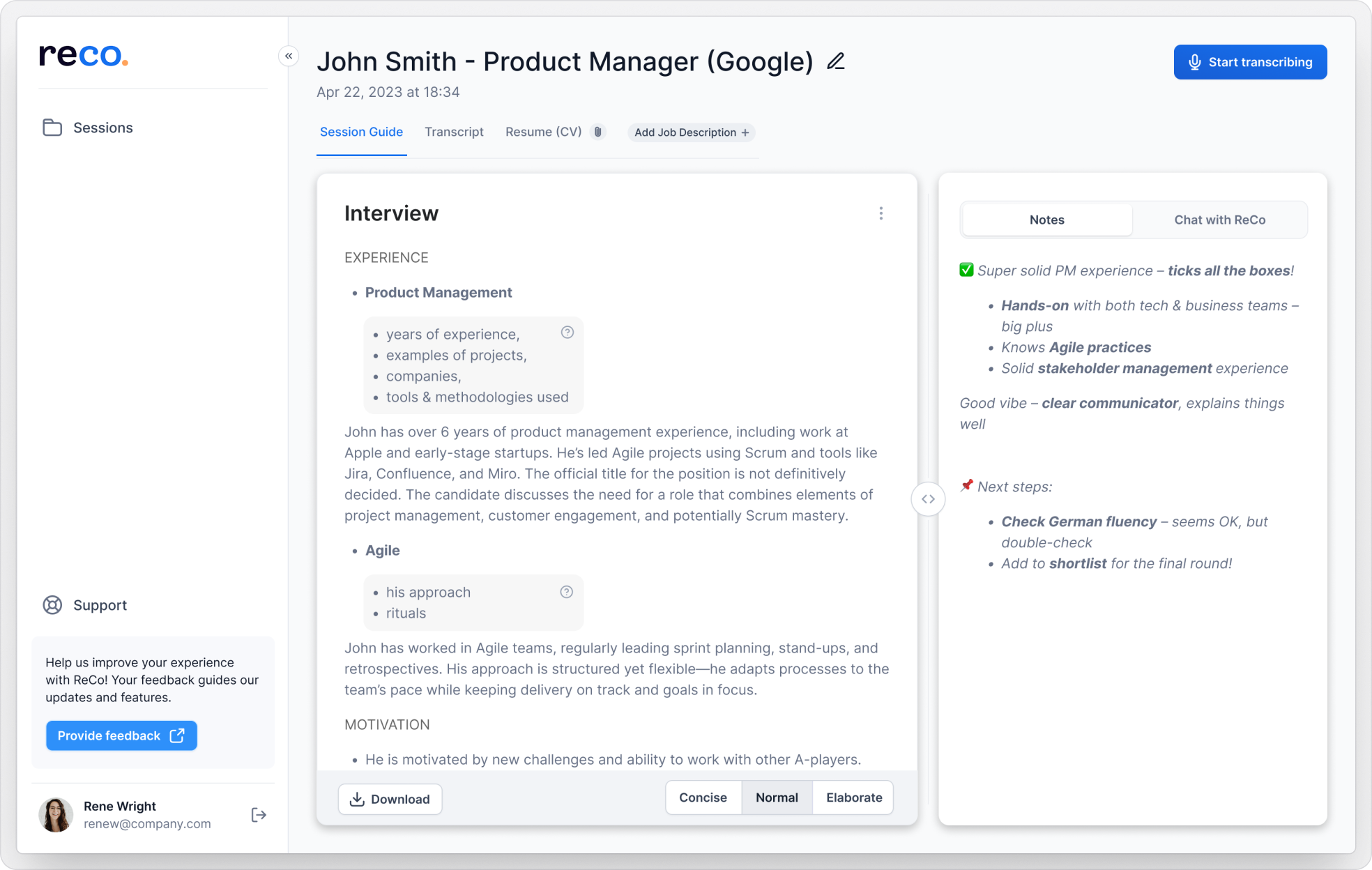
ReCoExecutive search selection workflow
 Metaview
Broader recruiting AI

General meeting AI
What this means in practice
A generic AI meeting assistant is built to capture meetings across many business contexts. Executive search software is built to support a narrower, higher-stakes workflow.
The difference becomes obvious when the consultant moves from interview evidence to candidate assessment, a recommendation report, and compliant follow-up - often across several active roles and back-to-back calls.
- The deeper the consultant's ownership of recommendation quality, the more the workflow category matters.
- The more the buyer values broad meeting coverage, the more a generic meeting AI may still be sufficient.
What changes when the use case is executive search
Short, category-led comparison for buyers evaluating executive-search workflow fit.
The category gap
Executive search interviews create downstream work that meeting AI does not fully absorb.
The transcript is only the beginning. Consultants still need to assess fit, shape recommendation logic, and deliver a client-facing document that sounds deliberate and defensible. When the CV, role brief, notes, and transcript live in separate tools, that work starts by rebuilding context. That is why the product category itself matters.

Healthy comparison logic
A meeting assistant is useful when the meeting is the main object.
An executive-search workspace is useful when the meeting is one step inside a larger candidate-selection and recommendation process. That is the distinction we want the page to make quickly and clearly.

What ReCo optimizes for
ReCo is optimized for fewer rewrites, stronger continuity, and better client delivery.
Instead of stopping at notes, the workflow stays connected through the interview, the assessment, the recommendation structure, and the final output. That continuity is what makes the tool feel specialized rather than generic.
Questions executive search consultants ask
Are generic AI meeting assistants bad for recruiters?
No. They can be useful for broad note-taking and meeting memory. They are simply solving a different problem than an executive-search consultant who needs structured assessment and client recommendation delivery.
When does a dedicated executive search workspace become worth it?
It becomes worth it when recommendation quality, confidentiality, and consultant time on writing are core economic constraints rather than secondary convenience issues.
Related executive search resources
Go deeper only if you want a narrower comparison or workflow topic.